Prebiotic Fibre vs Probiotics: Which One Do You Actually Need?
The short version
A prebiotic is a fermentable fibre that feeds the bacteria already living in your colon. A probiotic is a dose of live bacteria you swallow. The prebiotic evidence is broader and less strain-dependent; the probiotic evidence is strong but strictly specific — it belongs to individual named strains at named doses, not to the word “probiotic”.
- Prebiotic: fibre such as inulin, pectin or beta-glucan; feeds resident bacteria.
- Probiotic: live organisms; benefits are strain-specific and dose-specific.
- Label test: a real probiotic names genus, species, strain and CFU. No strain, no claim.

Two different products wearing one word
Walk the gut-health shelf and almost every box says “microbiome”. Underneath that word are two mechanisms that have almost nothing in common.
A probiotic is live micro-organisms which, in adequate amounts, confer a health benefit on the host — that is essentially the internationally used definition. You are swallowing organisms and hoping enough of them survive to do something on the way through.
A prebiotic is a substrate selectively used by host micro-organisms to confer a benefit. In practice that means fermentable fibre: inulin, fructooligosaccharides, galacto- oligosaccharides, resistant starch, pectin, beta-glucan. You are not adding bacteria. You are feeding the ones already there, which is a much less fragile proposition.
Why strain names matter for probiotics and nothing else does
This is the single most useful thing to know when reading a gut supplement label. Probiotic evidence does not generalise. A trial showing benefit for Lacticaseibacillus rhamnosus GG says nothing about a different L. rhamnosus strain, and certainly nothing about “Lactobacillus” as a genus. Effects live at the strain level, and strain designations are the alphanumeric codes after the species name.
So a credible probiotic label gives you four things: genus, species, strain designation, and colony-forming units per serving at end of shelf life — not at time of manufacture. A label that says only “multi-strain Lactobacillus and Bifidobacterium blend” has given you none of the four, and there is no way to look up what it should do.
“Contains Lactobacillus” is roughly as informative as “contains vegetables”. The evidence lives two taxonomic levels further down.
Why prebiotic fibre is the more forgiving purchase
Fibre has none of those fragilities. It does not need to arrive alive, it does not need refrigeration, it does not lose potency on a warm shelf, and it does not depend on whether a particular strain happens to colonise you. It is fermented in the colon into short-chain fatty acids — butyrate, acetate, propionate — which are the metabolites behind most credible gut claims, and it works with whatever ecosystem you already have.
It also has the boring advantage of being food. Oats, apples, legumes and psyllium have been eaten for as long as there have been people, and the safety record is measured in millennia rather than in trials. The realistic ceiling on the benefit is regularity, comfort, satiety and a measurable nutrition gap closed — not transformation.
The honest side effects
Fibre's tradeoff is gas. Fermentation produces it, and going from a low-fibre diet to a meaningful dose overnight is the standard route to a bloated, uncomfortable first week — which is ironic given that bloating is what most people buy these products to fix. The fix is to increase slowly, drink enough water for gel-forming fibres to work, and give it two to three weeks.
Fibre can also slow the absorption of some medicines, so separating a fibre supplement from prescription doses by a couple of hours is sensible practice worth confirming with a pharmacist.
So which one do you need?
| If your situation is… | The more sensible lever |
|---|---|
| You eat well under the recommended fibre intake — as most adults do | Prebiotic fibre, or simply more fibrous food |
| Irregularity and stool consistency | Fibre, psyllium especially |
| Recovering from a specific antibiotic course | A named probiotic strain studied for that indication |
| A diagnosed condition | A clinician, before either |
Where this leaves FloraNew
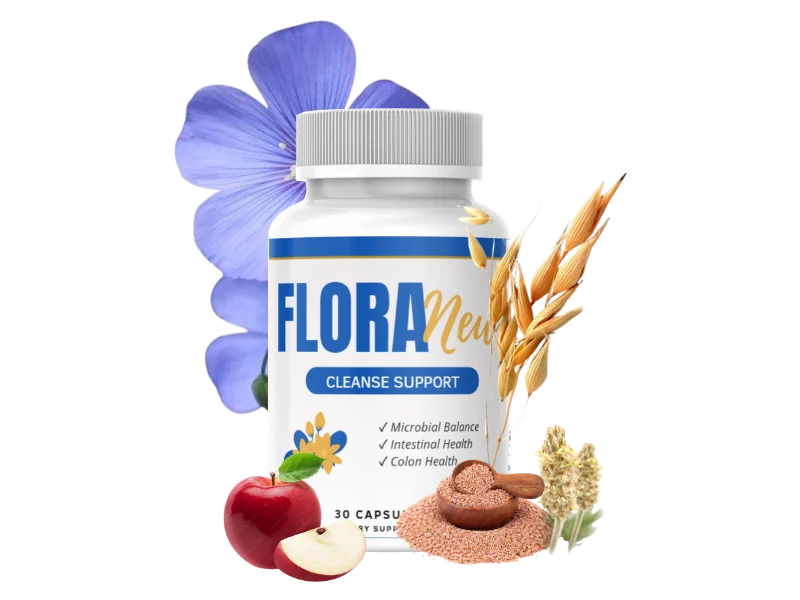
FloraNew is documented by its own ingredient sheets as a soluble-fibre product — oat bran and apple pectin — which puts it in the prebiotic column, where the evidence is broader and the label requirements are far less demanding. Its FAQ separately claims a probiotic blend, but gives no genus-species-strain and no CFU count, which is exactly the label pattern this article says to treat as unverified. Read it as a fibre capsule and the expectations are reasonable. Read it as a probiotic and the label does not support the claim. For the delivery side of the same question, see whether delayed-release capsules really survive stomach acid.
Two follow-on questions decide whether either column is worth your money. Timing matters far more for live organisms than for fibre, which is why choosing a time of day you will actually keep to is the highest-value habit here. And when you are standing in front of a shelf that mixes both columns into one box, our buyer's guide to reading strains, CFU, delivery and price is the checklist to apply.
See the capsule in context
FloraNew is a once-a-day delayed-release capsule. Here is the current official-store pricing and the 60-day guarantee.
Get OfferFrequently asked questions
Can one product be both a prebiotic and a probiotic?
Yes — that combination is usually called a synbiotic. But a genuine synbiotic label still has to name its strains and CFU count as well as its fibre, or half of the claim is unverifiable.
How much fibre should an adult get?
General guidance for adults sits in the region of 25 to 38 grams a day depending on age and sex, and average intake in the US is well below that. A capsule contributes a fraction of it, which is why food remains the main lever.
Do probiotics need refrigeration?
Some strains do and some are shelf-stable, which is why the CFU count should be stated at the end of shelf life rather than at manufacture. A count with no date basis tells you very little about what is in the bottle when you open it.