Probiotics and Bone Health After Menopause
Can probiotics support bone density after menopause?
Some randomized trials in postmenopausal women have linked specific probiotic strains to smaller one-year drops in bone mineral density and to shifts in bone-turnover markers. The signal is genuine but early and modest, it belongs to named strains rather than to “probiotics” as a group, and it never replaces calcium, vitamin D or medical care.
- The mechanism: the gut-bone axis links bacteria, calcium absorption and bone-cell signalling.
- The strains: effects are tied to coded strains such as L. reuteri 6475, not to a genus name.
- The limit: a supporting role at most; the foundation stays calcium, vitamin D and exercise.
Why menopause changes the bone equation
Bone is not the inert scaffold it looks like. It is living tissue in constant renewal: cells called osteoclasts dissolve old bone, and osteoblasts lay down new bone in its place. For most of adult life those two crews stay roughly in balance. Estrogen is one of the referees that keeps them there, restraining the osteoclasts so the demolition never outpaces the construction.
When estrogen falls at menopause, that restraint eases. Resorption speeds up, formation cannot quite keep pace, and the net result is faster bone loss — most steeply in the first several years after the final period. This is ordinary physiology, not a disease in itself, but it is the reason bone density and fracture risk get so much attention in this stage of life. It is also why women look harder at anything that might tilt the balance back a little, from resistance training to diet to, more recently, the bacteria in the gut.
The gut-bone axis, in plain terms
The idea that your intestines have anything to do with your hips sounds like a stretch until you look at the plumbing. Researchers now describe a “gut-bone axis”, and it runs along at least three roads.
The first is absorption. Calcium is the raw material of bone, and how much of it you actually take up depends partly on conditions in the gut. When resident bacteria ferment certain fibres, the local environment becomes slightly more acidic and mineral solubility improves, which some studies associate with better calcium uptake.
The second is short-chain fatty acids. Fermentation of fibre produces butyrate, acetate and propionate, and these molecules do more than fuel the colon lining. In laboratory and animal work they influence the immune cells that in turn tell osteoclasts when to switch on and off. The third road is that same immune signalling directly: estrogen loss shifts the balance of inflammatory messengers toward the ones that encourage bone resorption, and the microbiome is one of the systems that helps set that inflammatory tone. Change the ecosystem and you may, in principle, nudge the signalling.
None of this makes the gut a lever you can simply pull. It makes it a plausible participant, and plausibility is the reason the trials got funded in the first place.
What the probiotic bone trials actually measured
Here is the part worth reading slowly, because the headlines rarely do it justice. The best-known human evidence comes from randomized, placebo-controlled trials in postmenopausal women that ran for roughly twelve months and measured two things: bone mineral density by DXA scan, and blood markers of bone turnover.
In one influential trial, older women who took a specific Lactobacillus reuteri strain daily lost less bone at the tibia over a year than women on placebo. In separate work, a multi-species blend was associated with reduced levels of a bone-resorption marker. Those are real, peer-reviewed, controlled findings — not testimonials.
They are also modest and preliminary. The differences were in the range you detect with careful instruments over a year, not transformations you would feel. Bone-turnover markers are a stepping-stone measurement, useful for showing that something is happening biologically but not the same as proving fewer fractures years down the line. And trials of this kind are still relatively few, with varied strains, doses and populations, which is exactly the situation where enthusiasm tends to run ahead of the data.
A one-year change in a turnover marker is a hint about mechanism. A lower lifetime fracture risk is the outcome that matters, and no probiotic has earned that claim.
Which strains showed up in the research
If you take one practical thing from this article, take this: bone effects, where they exist, belong to named strains at named doses, and to nothing else. The most-cited postmenopausal work used Lactobacillus reuteri ATCC PTA 6475. Other trials built multi-species formulas around Lactobacillus acidophilus, Lacticaseibacillus paracasei and Lactobacillus plantarum. Those alphanumeric codes and species names are the evidence.
A product that lists only “Lactobacillus blend” with no species, no strain code and no colony-forming-unit count has told you nothing you can check against the literature. There is no way to know whether it contains the studied organism, a cousin that behaves differently, or a strain no one has tested for bone at all. If you are shopping specifically for the bone signal, that label detail is the whole game — a point we make in more depth in prebiotic fibre versus probiotics.
The honest limits of this evidence
Three cautions keep the picture straight. First, absence of long-term fracture data: the trials measured density and markers over months, not broken bones over decades, so the clinically important endpoint is still an open question. Second, heterogeneity: different studies used different strains and doses, and you cannot pool them into a single tidy conclusion. Third, individual variation: your existing microbiome, diet and hormone status all shape whether an introduced strain does anything at all in you specifically.
This is why the responsible summary is neither “probiotics build bone” nor “it is all hype”. It is: a specific, plausible, early line of research exists, it points at a small supporting effect for particular strains, and it deserves neither a marketing halo nor a dismissal.
Where calcium, vitamin D and exercise still sit
Nothing in the probiotic literature displaces the foundations. Adequate calcium and vitamin D remain the raw material and the delivery system for bone, and public-health bodies set intake targets for both precisely because bone depends on them. Weight-bearing and resistance exercise remain among the few interventions shown to load bone in a way that encourages it to hold density. And for women at elevated risk, prescription therapies exist that have fracture-reduction evidence a supplement cannot match.
The most sensible framing is a pyramid. The wide base is calcium, vitamin D, protein and movement, plus the medical care your risk warrants. A probiotic, if you and your clinician decide to try one, sits near the top as a small possible extra — most reasonably a strain studied for the purpose, taken with realistic expectations and a plan to reassess.
Where FloraNew fits — and where it does not
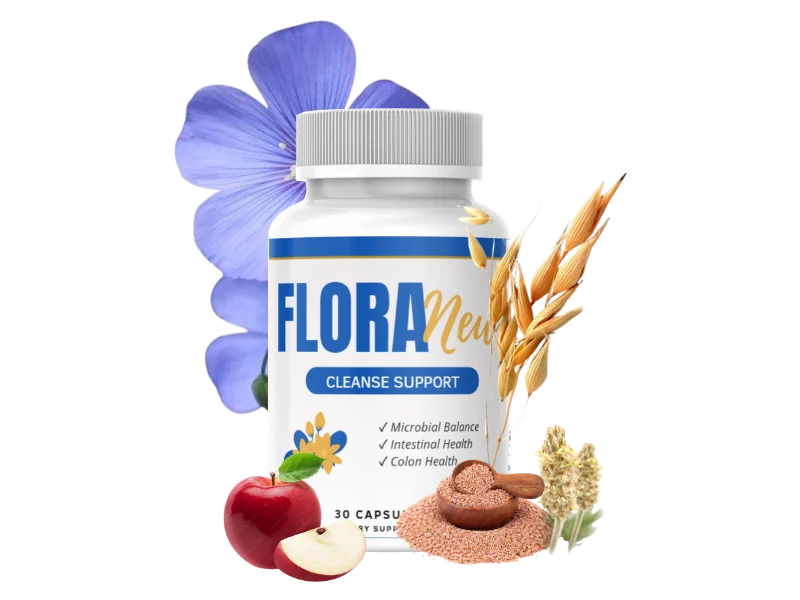
FloraNew is documented by its own ingredient sheets as a soluble-fibre product built around oat bran and apple pectin. That places it on the prebiotic side of the gut story: it is the kind of fermentable fibre that feeds resident bacteria and becomes the short-chain fatty acids described above. That is a coherent, food-grounded role.
It is not, however, a bone product, and it should not be read as one. FloraNew makes no bone-density claim, and its label does not carry the genus-species-strain designation or the CFU count that the bone trials depended on. If you came to this page hoping a fibre capsule would stand in for the postmenopausal bone research, the honest answer is that it will not — the studied effect belongs to specific probiotic strains, not to soluble fibre, and certainly not to any product that has not been tested for it. Treat FloraNew as what its ingredient sheets describe, keep the calcium, vitamin D and exercise foundation in place, and take any bone concern to a clinician who can order a scan.
See the capsule in context
FloraNew is a once-a-day delayed-release soluble-fibre capsule. Here is the current official-store pricing and the 60-day guarantee.
Get OfferFrequently asked questions
Can probiotics support bone density?
Some randomized trials in postmenopausal women have reported smaller declines in bone mineral density and shifts in bone-turnover markers with specific probiotic strains over a year. The signal is real but early, the effect sizes are modest, and it does not apply to probiotics as a category. No supplement should be treated as a stand-in for a bone-density scan or medical care.
How does the gut affect bone health?
This is called the gut-bone axis. Gut bacteria ferment fibre into short-chain fatty acids, influence how much calcium you absorb, and help shape the immune signalling that drives bone-building and bone-resorbing cells. When estrogen falls at menopause, that immune signalling tilts toward faster bone breakdown, which is where researchers think the microbiome may play a supporting role.
Which strains were studied for bone?
The most-cited postmenopausal work used Lactobacillus reuteri ATCC PTA 6475 and multi-species blends built around Lactobacillus acidophilus, Lacticaseibacillus paracasei and Lactobacillus plantarum. Effects belong to those named strains at the doses tested, not to any product that simply lists Lactobacillus on the label without a strain code or a CFU count.
Do probiotics replace calcium or vitamin D?
No. Adequate calcium and vitamin D, weight-bearing exercise and, where a clinician advises it, prescription bone therapy remain the foundation. At best a probiotic is studied as something that might help the body use those inputs more efficiently. It is an addition to consider with your doctor, never a substitute for the basics.
Related reading
References
- NIH Office of Dietary Supplements — Calcium Fact Sheet for Health Professionals.
- NIH Office of Dietary Supplements — Vitamin D Fact Sheet for Health Professionals.
- National Center for Complementary and Integrative Health — Probiotics: What You Need To Know.
- National Institute of Arthritis and Musculoskeletal and Skin Diseases — Osteoporosis overview.